Boat day
El Cielo and Palancar
The site tour
- Time4 to 4.5 hours
- StopsPalancar reef and El Cielo
- GroupLimited to 14 participants
- Pricefrom $72
Group price check
Summary
Palancar Gardens and the Bricks are named parts of a single long reef whose crest lies far below the surface.
Reef anatomy in brief
3 options compared
Choose how many people are going, then compare what each Palancar boat day would cost you.
≈
View≈
View≈
ViewFigures are GetYourGuide from-prices, translated at the ECB reference rate. The booking step shows what you pay exactly.
The park names Palancar's parts in Spanish and measures the shelf in terraces. Here is where Gardens, Horseshoe, Caves and Bricks sit, how deep each level goes and what that means from the surface.
Editorial team, palancarsnorkel.quest · Updated November 24, 2026 · Quick read: 7 min
Facts at a glance
Palancar is not a single spot but a family of named sites. The decree of 1996 that created the national park7 lists Palancar among its most important reefs and gives it named parts: Jardines, La Herradura and Cuevones,1 which read in English as Gardens, Horseshoe and Caves. The English forms are the ones you may meet on a dive menu, whereas the listings say simply Palancar reef, and both point into the same long reef. The park as a whole covers 11,987.88 ha, and 11,905.60 ha of that is sea.8,9
The later management program goes a step further and lists four Palancar reefs in its zoning: Cuevones, Jardines, La Herradura and Ladrillos, the last of which means Bricks.2 The two documents differ by one name, and Palancar Bricks appears only in the later one. The program places all of them inside a reef zone that runs out to the 100 m depth line, so all of them lie inside the protected area.2
Palancar Gardens is the name most travellers type into a search box, yet the park papers give no map of where Gardens ends and Horseshoe begins. What they do give is the big picture. Officially Palancar and Colombia are one reef, a chain of coral some 6 to 7 km long that follows the lip of the slope,3 so the names mark stretches of one long line of coral and not separate islands of it.
Level by level
| Level | Depth | What the program says |
|---|---|---|
| First terrace | 0.5 m to 4 m10 | A gentle slope near the surface |
| First step | 4 m to 10 m11 | Drops between the first and second terrace |
| Second terrace | A steady 10 m12 | Holds some aligned patches in Palancar Bay19 |
| Second step | 10 m to 15 m13 | Forms the platform edge around Palancar14 |
| Third terrace | 15 m to 20 m15 | Almost gone around Palancar14 |
| Shelf edge | 20 m to 30 m16 | The slope then drops almost vertically16 |
| Reef top near Punta Sur | 16 m to 21 m4 | A single crest of separate blocks4 |
Depths are those of the management program and the Ramsar sheet, both written by Mexico's protected-areas commission; the program summary dates from 1998.20
Ladrillos is the Spanish word for bricks, and the park uses it for a named part of Palancar without describing it. In August 2020 the park announced a rest period for its restricted-use area, which includes Palancar Cuevas, Palancar Ladrillos and three Colombia sites, from August to 30 September 2020.17 That notice shows that the Bricks and the Caves are named dive sites inside the park's restricted-use zone, a detail the listings never mention.
Cuevones, the Caves of the decree, is named alongside Gardens and Horseshoe, but the decree and the program give it neither a depth nor a cave length. Depth figures for these sites that you meet on a dive menu come from operators and not from the park papers. What the program does say is structural: around Palancar the second step forms the edge of the platform, and huge reefs grow along that edge.14
For a visit this matters in a practical way. On the site tour a single boat day covers Palancar reef and El Cielo, and the 3 reefs listing gives 25 minutes to Playa Palancar among its stops. Neither listing says which part of Palancar the boat uses, so treat Gardens, Horseshoe, Caves and Bricks as names to ask the crew about, never as promises made in advance. A good crew will say where it plans to stop, and that answer is worth more than any brochure line.
The management program describes the shelf off Cozumel as a staircase. The first terrace starts near 0.5 m and shelves gently down to 4 m,10 then the first step drops from 4 m to 10 m,11 and the second terrace lies at a steady 10 m.12 Those are the levels closest to the surface, and they are the water a beach swimmer or a shallow snorkel stop works in. Counting from the shore outward, each level is a ledge or a flat before the next drop.
Below that the staircase keeps going. The second step usually drops from 10 m to 15 m,13 and the third terrace slopes from 15 m to 20 m.15 Around Palancar the third terrace has almost disappeared, so the second step forms the edge of the platform and huge reefs grow right along it.14 Palancar Bay also holds some aligned reef patches on the second terrace, a shallower detail in the program's description.19
Deeper still the shelf ends. The Ramsar sheet says the western island shelf finishes between 20 and 30 m, and the slope then falls almost vertically to more than 400 m,16 with a terrace at a constant 30 m north and south of the western platform.18 So the depth of Palancar depends on where you measure: terraces from the surface down to 20 m, a shelf edge at 20 to 30 m, and open water beyond.15,16
Pick by depth
Tap your priority and the best-fitting level or option shows up next to it.
If I want to float over the reef
A snorkel boat day
The reef top near Punta Sur lies 16 to 21 m down, so a snorkel stop is a view from above.4
If I want to be among the reef blocks
A guided dive
Recreational dives are capped at 45 m by the 1998 program and need an authorised guide.5,21
If I want the shallowest water
El Cielo or Chankanaab
El Cielo is a shallow sandbar, and Chankanaab, also inside the park, has a reef near enough to the shore for snorkelling.22,23
If I worry about closures
Ask the operator first
Palancar was partly closed from 7 October 2019 and rested again in 2020, so dates matter.6,17
If I want the Caves or the Bricks
A dive centre
Both are named in the restricted-use rest notice of August 2020.17
Boat days that stop at Palancar
Boat day
The site tour
Boat day
Palancar, Columbia, El Cielo
Boat day
A sandy beach stop too
Near Punta Sur the program describes the reef as a single crest made of separate blocks, with the top of that crest 16 to 21 m beneath the surface.4 The same program also records a shallower formation at Palancar, 2 km at its longest and 100 m wide on average.29 Together those two descriptions show a reef with both a deep spine and a long shallower body. Both come from the same program, so the figures sit on one scale.
The living structure is mostly Montastrea annularis, the species the program says builds the Colombia and Palancar reef. Its colonies are very numerous and vary in size, with most measuring less than 1 m around and 2 m tall.30 That is a reef of many modest, close-packed colonies and not of a few giant domes, which is worth picturing before you imagine an underwater cathedral. The program also names the giant barrel sponge, Xestospongia muta, among the park's sponges,31 a reminder that sponges share the reef with the corals.
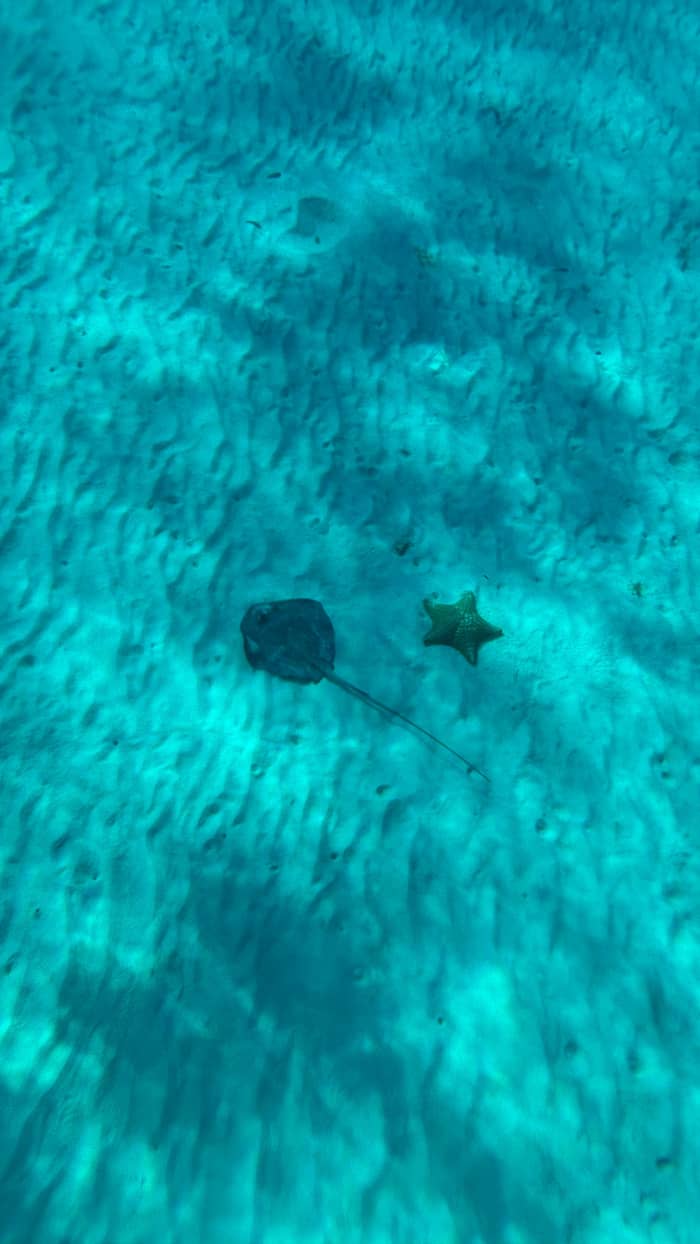
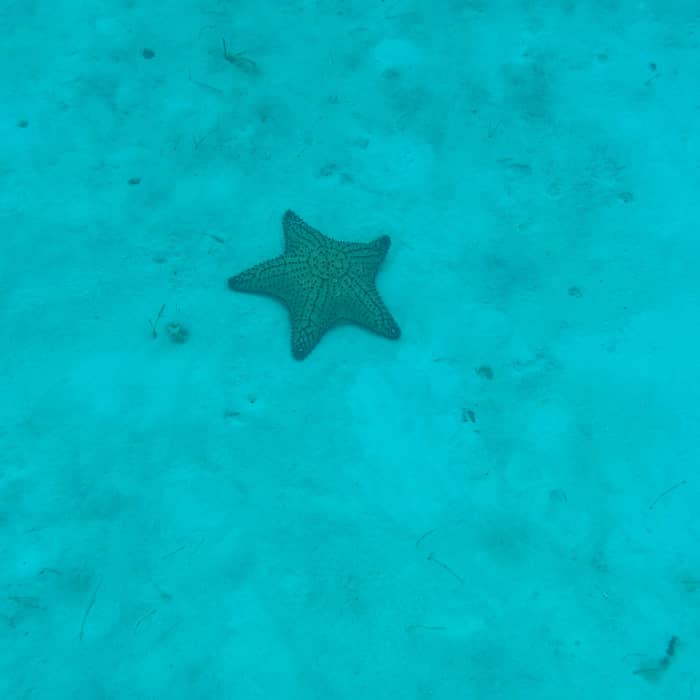
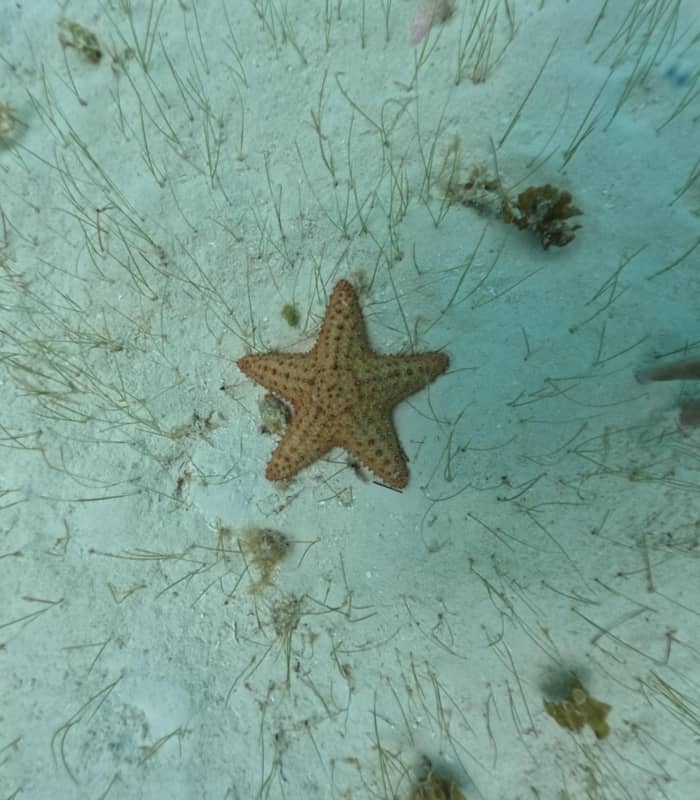
For someone floating at the surface these numbers set expectations. A crest top that deep is out of reach of a snorkeller, so the view from above is about clear water and whatever swims into sight: the tourism board describes exceptionally clear water over the Palancar, Colombia and Santa Rosa reefs.32 The same boat day adds El Cielo, which the board calls a shallow sandbar with clear water, known for its starfish.22
A descent, level by level
Near the surface
It starts near 0.5 m and shelves gently down to 4 m.10
Down the first step
The step drops from 4 m to 10 m and the terrace then holds a steady 10 m.11,12
The second step
It usually drops from 10 m to 15 m and forms the edge where huge reefs grow.13,14
The third terrace
It slopes from 15 m to 20 m and has almost vanished around Palancar.15,14
The shelf edge
Between 20 m and 30 m, then a slope that falls to more than 400 m.16
The program also sets rules by depth and by activity. Its reef zone, which includes the Palancar reefs Cuevones, Jardines, La Herradura and Ladrillos, runs out to the 100 m depth line.2 Inside the park the authorised depth for recreational diving is capped at 45 m,5 a figure from a program whose summary appeared in 1998,20 so confirm it with any dive centre that plans to go deep. Both numbers are old, so use them as a starting question for the dive centre and not as the final word.
Snorkelling is covered too. The program defines free diving as swimming combined with the observation of underwater wildlife, helped by a snorkel, mask, fins, weight belt and life vest,33 and it says recreational snorkelling and scuba must be supervised by at least 1 authorised guide.21 The rule that matters most to a first-timer is the simplest one: go with a guide who is allowed to be there.
Group size and distance are limited as well. The program's table of infractions lists more than 8 snorkellers per guide as a breach,27 and it lists diving within 1.5 m of coral formations as another.25 Touching, standing on, holding or dragging gear over the reef is forbidden, shallow areas included,26 and gloves and knives are forbidden gear.34 Those are the numbers worth knowing before you choose a boat.
Video
Oleg Shatalov on YouTube · Video data is requested only when you tap play.
Around Palancar the second step forms the edge of the platform, and enormous reefs nevertheless grow on that edge.
Before you go
Palancar's depth is not the only thing that changes over time. In late September 2019 CONANP said it would pause part of the tourist activity on Palancar, Colombia and the El Cielo site from 7 October, citing white syndrome, a coral disease.35,6,36 The suspension covered 3 of the park's 14 reef complexes.37 Both dates come from the park's own notices, so they describe policy at the time and not today's calendar.
By 21 January 2020 the park said tourism was allowed again in the Palancar and Colombia reef zones, with the notice giving 31 March 2020 as the date to which activity was open,38 and it announced a plan of rotating rests for dive and snorkel sites from 1 April 2020.28 The August 2020 rest period for the Palancar Caves and Bricks then ran to 30 September.17 Together these show a reef managed by rotation, not a fixed list of open sites.
Those notices are old, and the park itself says the planned strategies can change with the conditions of the zone.39 The practical advice is simple: ask the operator which Palancar site is open on your date, and remember that the site tour may be canceled for weather, and that a full refund needs cancelling a day ahead. A short message before you pay costs nothing, and the answer decides whether the day matches your plans.
FAQ
The management program counts Palancar and Colombia as a single coral structure, almost unbroken, following the lip of the slope for about 6 or 7 km.3
The listing runs 4 to 4.5 hours and sends the boat to Palancar reef first and El Cielo after it, with a beach stop to finish.
Sources
Planning a Palancar snorkel? Ask a real person here.